Labour Supply
EC306- Wages and Employment
Justin Smith
Wilfrid Laurier University
Fall 2026

Preferences
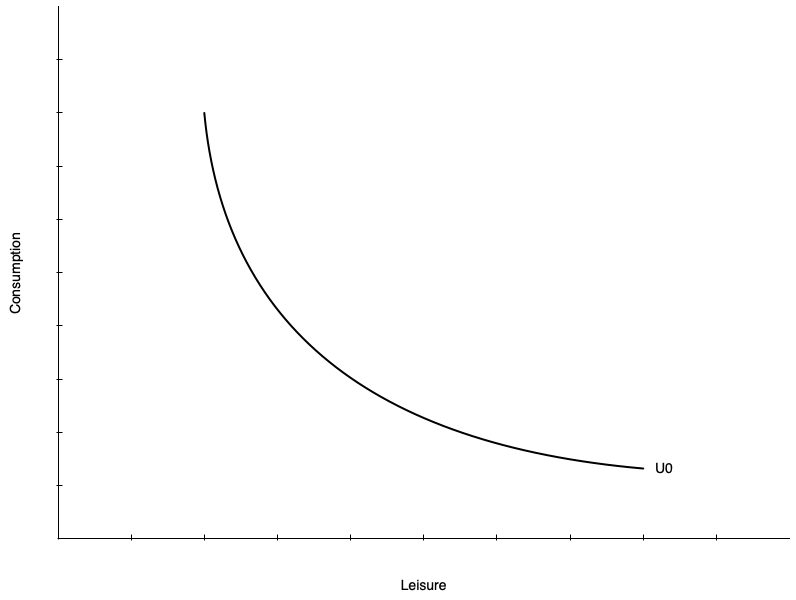
- On the left is a single indifference curve
- Any point represents equal utility (\(U_{0}\))
Key Definition
Marginal Rate of Substitution (MRS): the rate at which a person is willing to trade consumption for leisure while remaining equally happy
- The MRS is the slope of the indifference curve at a point
- Individuals have diminishing MRS
- Willing to give up less consumption for additional leisure the more leisure they already have
- Slope gets shallower with more leisure
Preferences
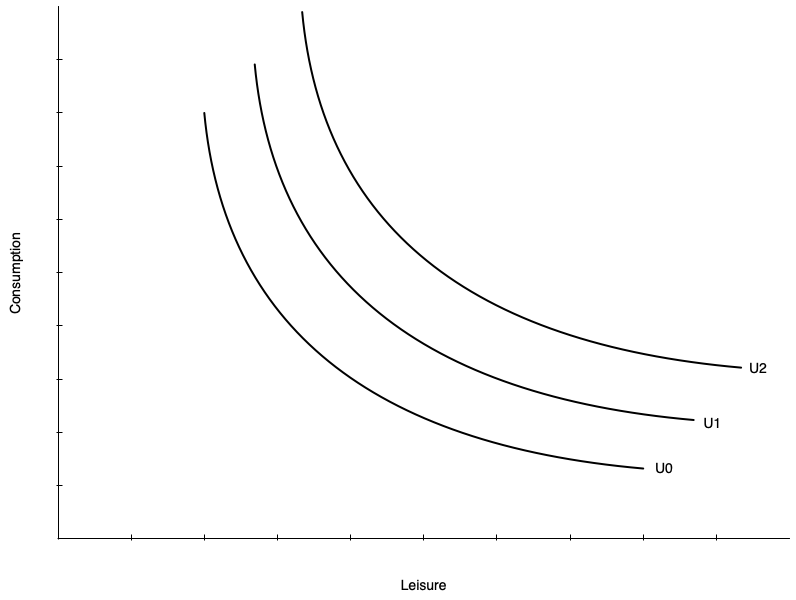
- Utility increases with curves further from the origin
- \(U_{2} > U_{1} > U_{0}\)
Constraints
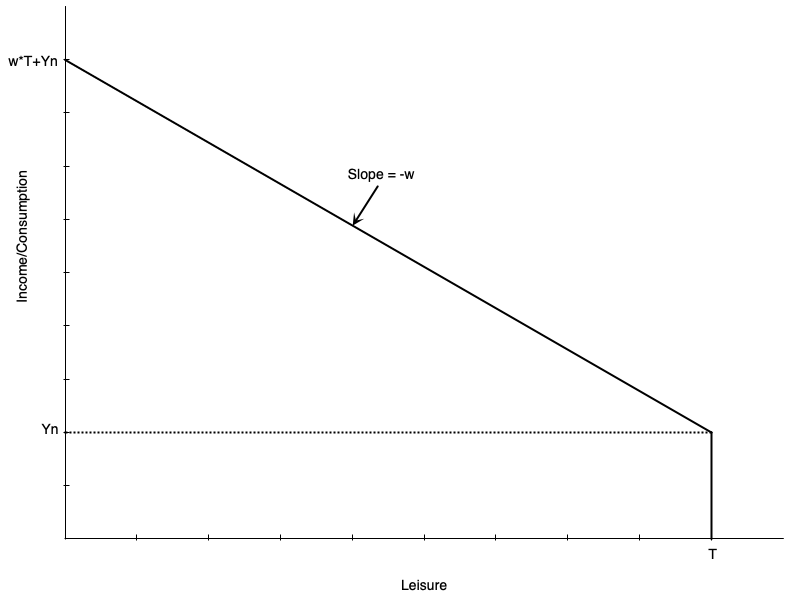
- Graph shows a linear budget constraint
- Assume no saving, so consumption = income
- There are \(T\) total hours to allocate to work or leisure
- Individual earns \(Y_{n}\) non-labour income
- Earned even with zero work hours (full leisure hours)
- Each hour worked gets wage of \(w\)
- Person working \(T\) hours (no leisure) earns \(wT+Y_{n}\) income
- Called "full income"
Constraints
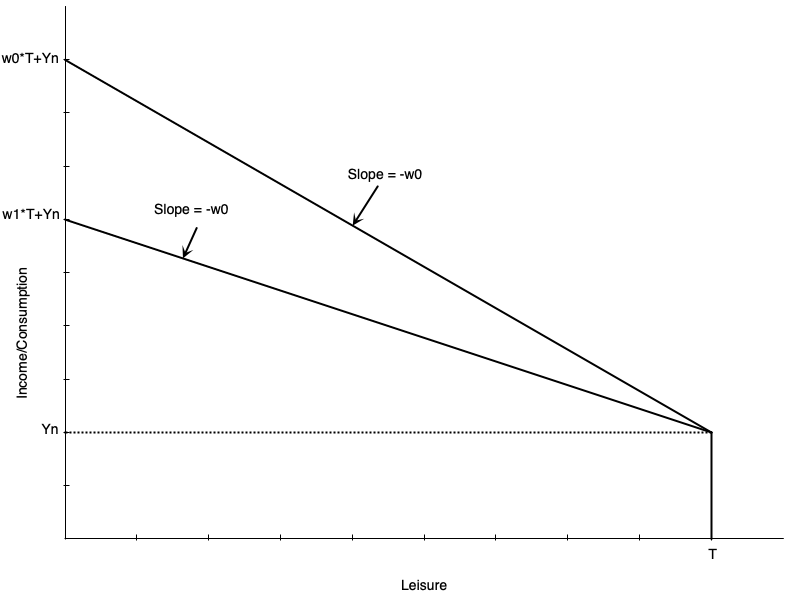
- Slope is the negative of the wage rate \(w\)
- A lower wage means shallower slope
- If \(w_{1} < w_{0}\), the budget line swivels down
- They intersect at leisure = \(T\) because there are no work hours
- Lower wage also means full income is lower
- Working all hours leads to less total labour earnings
Constraints
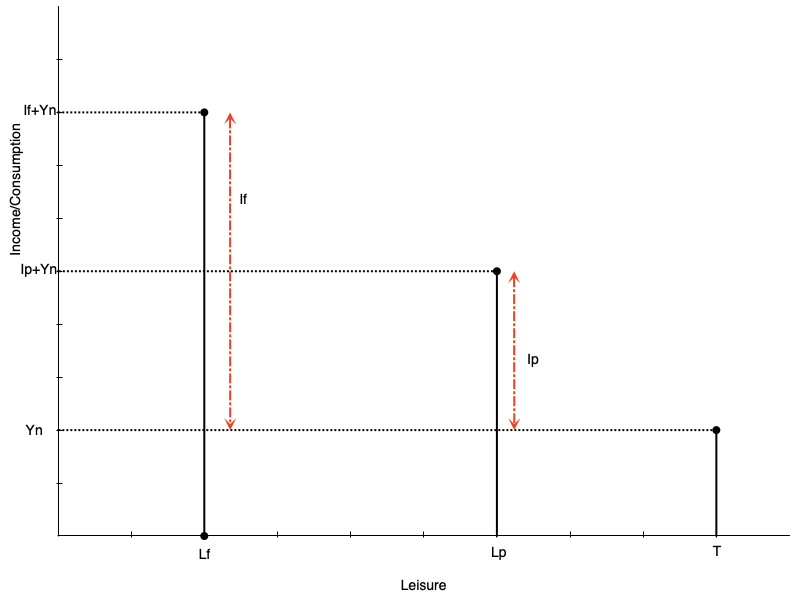
- Often people cannot adjust their work hours freely
- They may only be able to work full time or part time
- Budget constraint is no longer a line, but a set of points
- Suppose an individual chooses part time work
- Work hours are \(h_{p} = T-L_{p}\)
- Labour earnings are \(I_{p} = w*h_{p}\)
- Total consumption (and income) is \(C_{p} = I_{p} + Y_{n}\)
Constraints
- A person working full time hours
- Work hours are \(h_{f} = T-L_{f}\)
- Labour earnings are \(I_{f} = w*h_{f}\)
- Total consumption (and income) is \(C_{f} = I_{f} + Y_{n}\)
- In theory wage could also be different for full time work
Consumer Optimum
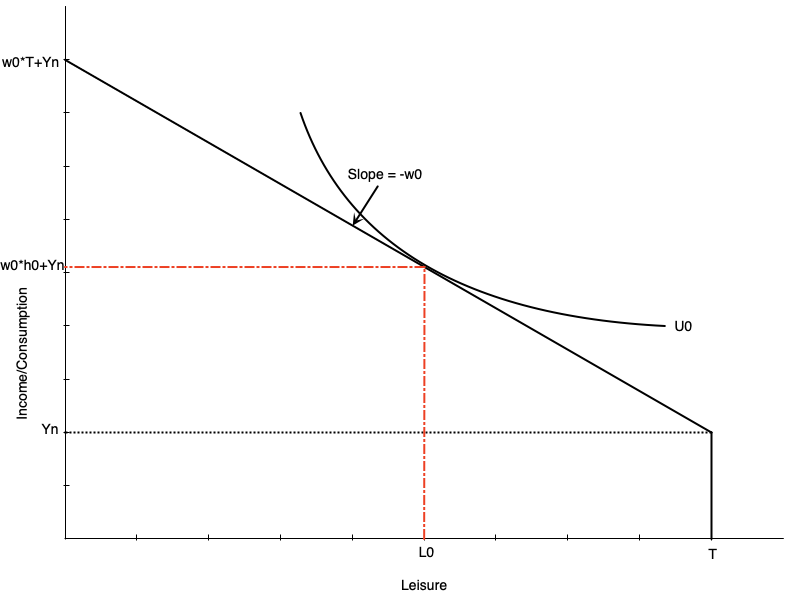
- Graph shows an optimum with participation
- Optimum is where indifference curve is tangent to budget constraint
Tip
At the optimum, MRS = wage rate
- Willingness to trade leisure for consumption (MRS) equals ability to trade them (wage)
- Optimal work hours are \(h_{0} = T - L_{0}\)
- Optimal consumption is \(C_{0} = W_{0}h_{0}+Y_{n}\)
Consumer Optimum
Key Definition
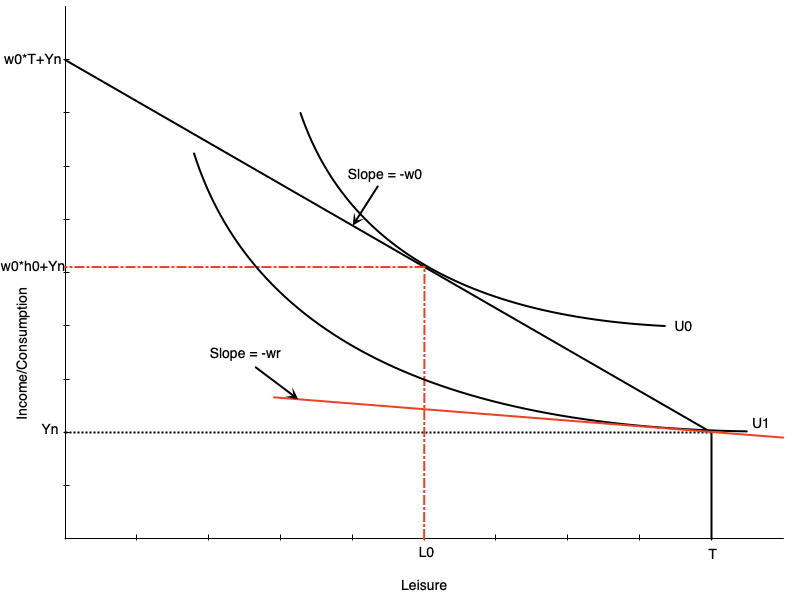
Reservation wage: the lowest wage at which a person will choose to work
- It occurs where the budget constraint is tangent to the indifference curve at full leisure
- At that point, MRS = reservation wage
- If the wage is any lower, the person will choose not to work
- If it is any higher, they will work positive hours
- The red line shows the hypothetical reservation wage
- In this case, it is \(w_{r}\)
Consumer Optimum
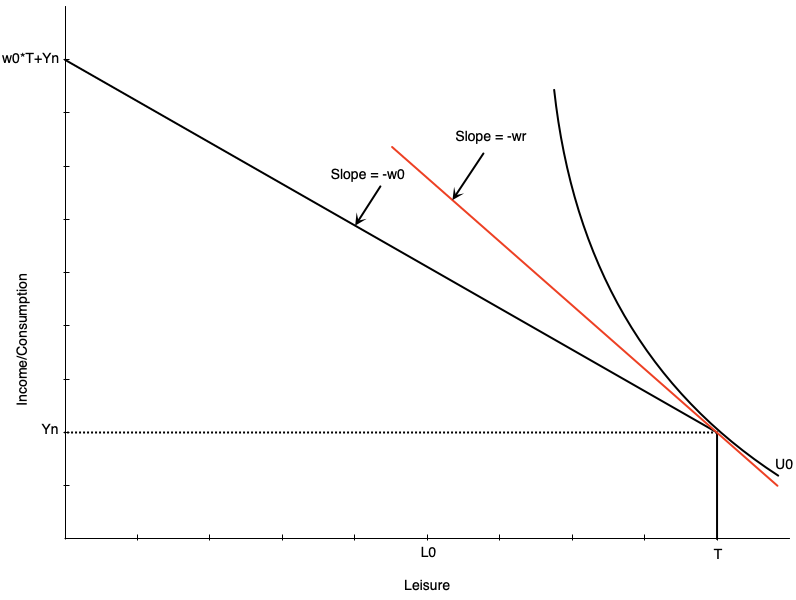
- Graph to the left shows a non-participation optimum
- The slope of the indifference curve is steeper than the budget constraint at full leisure
- The extra consumption you want from one less hour of leisure (MRS) is more than you can get from working an hour (wage)
- So your optimal choice is to not work at all
- Indifference curve touches the budget constraint at the kink
- Notice the wage \(w_{0}\) is lower than the reservation wage \(w_{r}\)
Increase in Non-Labour Income
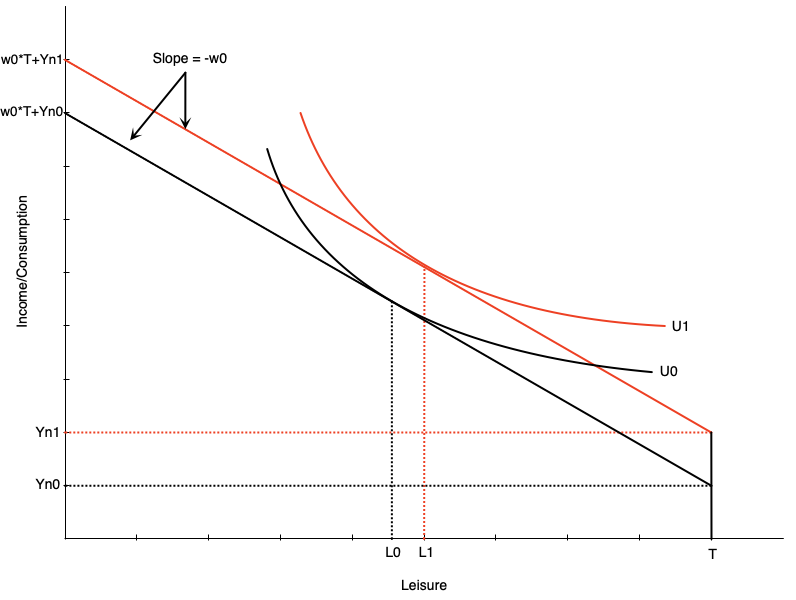
- Graph shows an increase in non-labour income from \(Y_{n0}\) to \(Y_{n1}\)
- Budget line shifts up vertically but parallel
- No change in slope because wage is the same
- If leisure is a normal good, optimal leisure increases from \(L_{0}\) to \(L_{1}\)
- Means work hours decrease by the same amount
- Consumption also increases
- This illustrates a pure income effect
- Increases in income increase demand for normal goods
Increase in the Wage
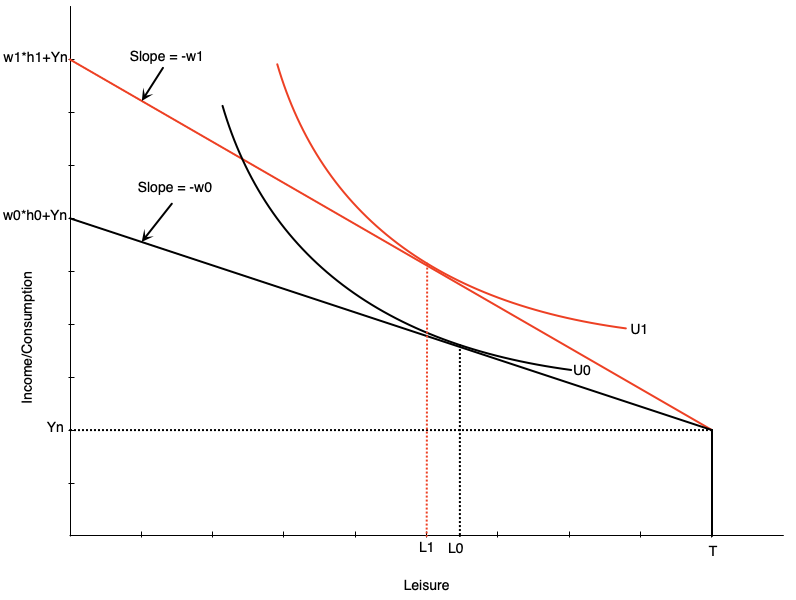
- If the wage changes, the budget constraint pivots
- In graph to the left, the wage increases from \(w_{0}\) to \(w_{1}\)
- The slope becomes steeper
- Full income also increases because working all hours earns more
- Graph is drawn such that leisure falls from \(L_{0}\) to \(L_{1}\) at the new wage rate
- There are two effects underlying this change
- Substitution effect
- Income effect
Increase in the Wage
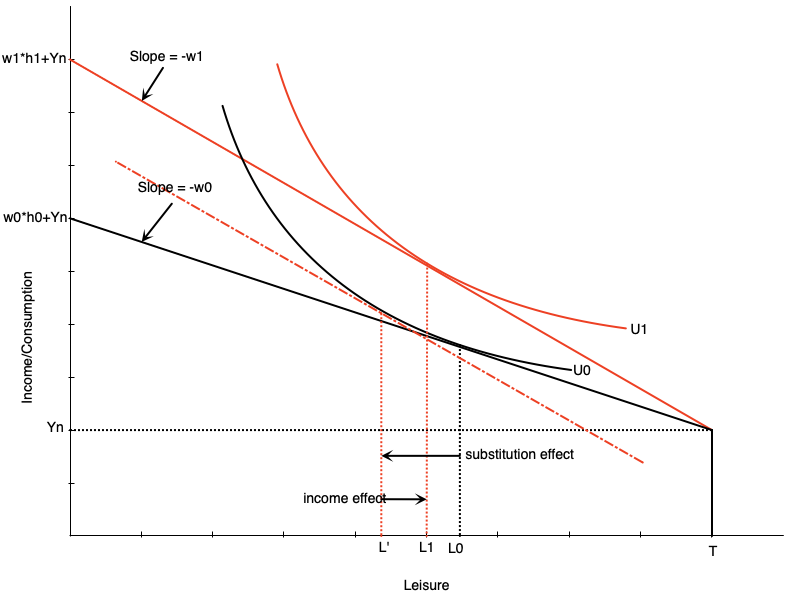
Key Definition
Substitution Effect: change in leisure when wage changes but utility is held constant
- When wage increases, leisure becomes more expensive
- People substitute away from leisure and towards consumption
- To measure this, draw a hypothetical budget line with the new slope but tangent to the original indifference curve
- Difference in leisure measures substitution effect
Increase in the Wage
Key Definition
Income Effect: change in leisure when income changes but wage is held constant
- When wage increases, workers become richer at same hours of work
- Want to consume more of all normal goods
- To measure this, move from hypothetical budget line to new budget line
- Difference in leisure measures income effect
Increase in the Wage
- The income and substitution effects move in opposite directions
- For a wage increase
- Substitution effect encourages more work (less leisure)
- Income effect encourages less work (more leisure)
- The overall effect on work hours depends on which effect is stronger
- Graph on the left shows a stronger substitution effect
Increase in the Wage
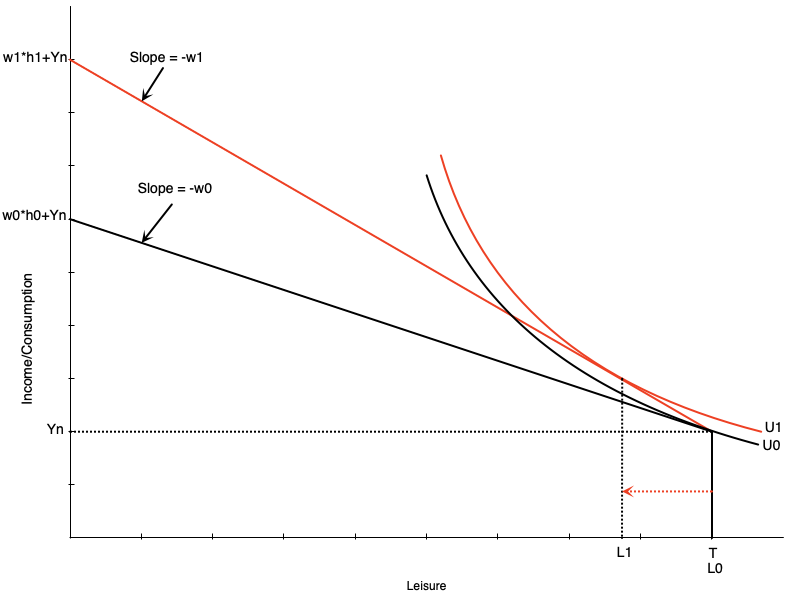
- Changing the wage can also affect participation
- Recall that workers do not work if the wage is below their reservation wage
- If an increase in the wage moves it above the reservation wage, they will start working
- Graph to the left shows how this would happen
The Individual Labour Supply Curve
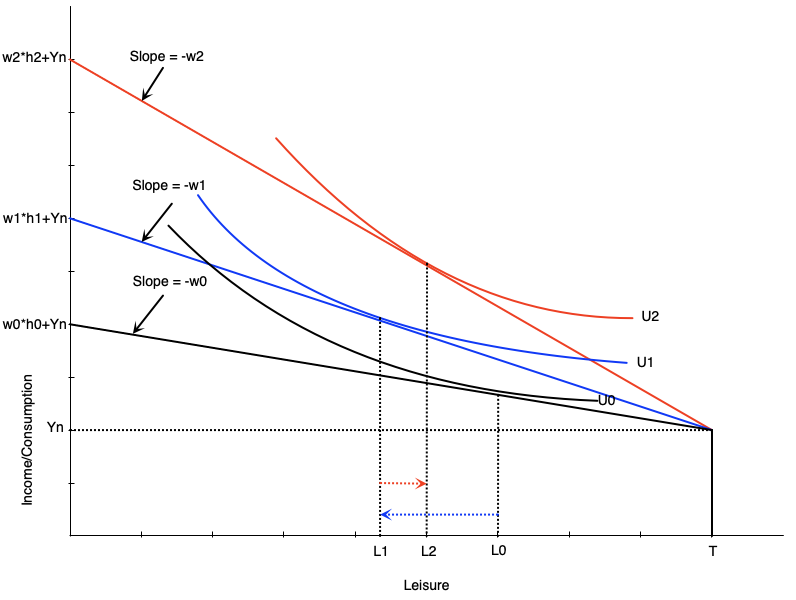
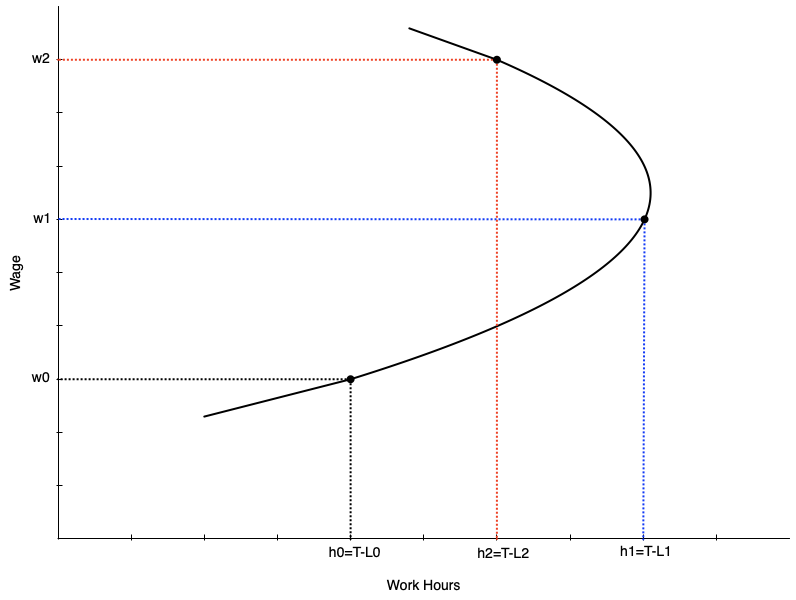
- Suppose wage goes from \(w_{0}\) to \(w_{1}\) to \(w_{2}\)
- At \(w_{0}\), work hours are \(h_{0} = T - L_{0}\)
- At \(w_{1}\), work hours increase to \(h_{1} = T - L_{1}\)
- substitution effect stronger
- At \(w_{2}\), work hours decrease to \(h_{2} = T - L_{2}\)
- income effect stronger
The Individual Labour Supply Curve
Participation

Elasticity of Labour Supply
Added Worker Effect
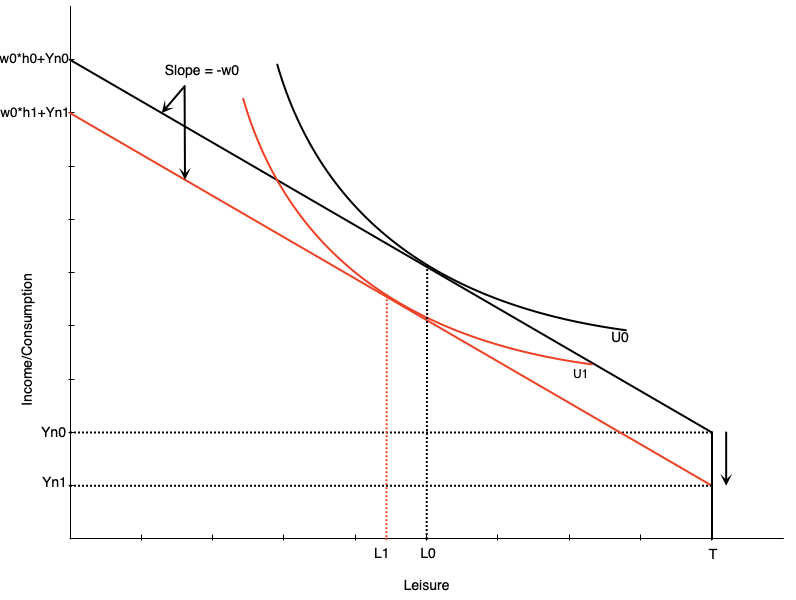
- When non-labour income falls, the budget constraint shifts down
- If leisure is a normal good, optimal leisure falls from \(L_{0}\) to \(L_{1}\)
- Work hours increase from \(h_{0}\) to \(h_{1}\)
- Means that the spouse increases work hours to compensate for lost family income
Added Worker Effect
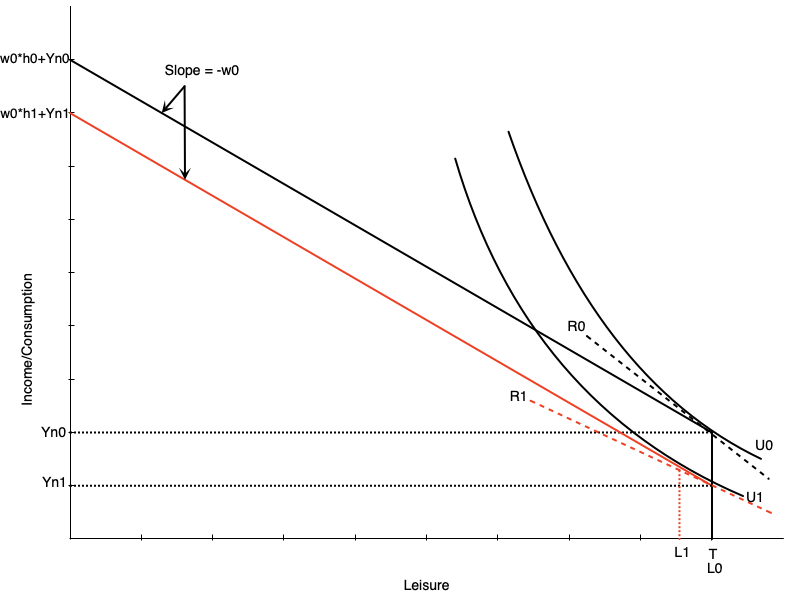
- If the spouse was not already working, the fall in income can induce participation
- Happens because the fall in income reduces the reservation wage
- If the wage is now above the reservation wage, they will start working
- Graph to the left shows how this happens
- The slope of reservation wage \(R_{1}\) is smaller than \(R_{0}\) after the drop in non-labour income
- Person enters the labour market in response because wage is now above reservation wage
Rigid Schedules and Flexible Work Hours
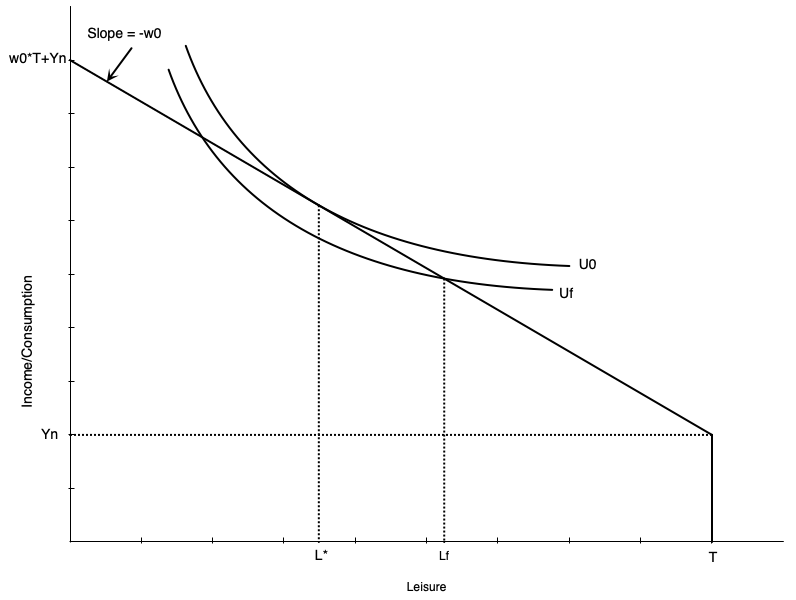
- In this graph people ideally would work \(h^* = T-L^*\) hours
- Maximizes utility subject to budget constraint
- Can only work \(h_f = T- L_f\) hours at their main job
- Employer does not allow more hours
- This puts them on a lower indifference curve \(U_f\)
- The outcome is not optimal
Rigid Schedules and Flexible Work Hours
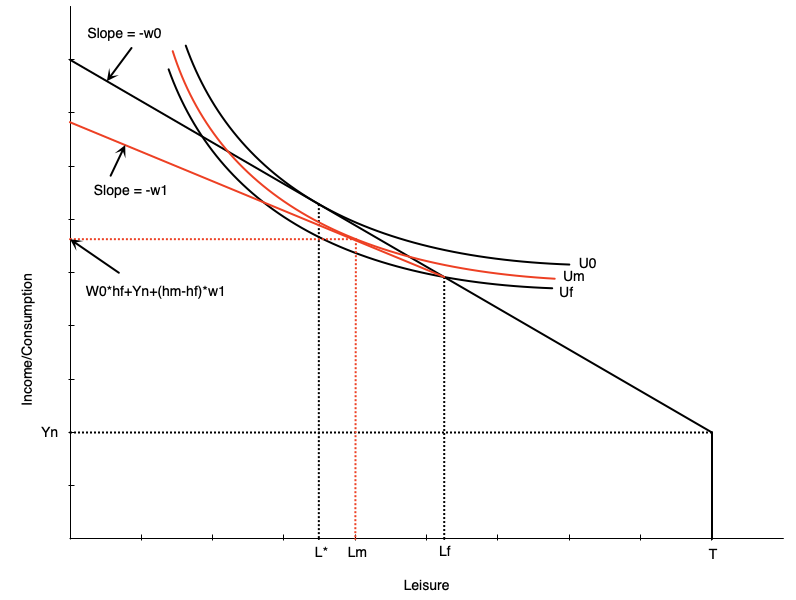
- Now imagine they can take a second job at a lower wage rate
- The budget constraint pivots out from the fixed hours point
- Beyond those hours, the wage falls
- Allows worker to access higher utility curve
- They can increase hours worked
- But not as much as if they could extend hours in main job
Overtime
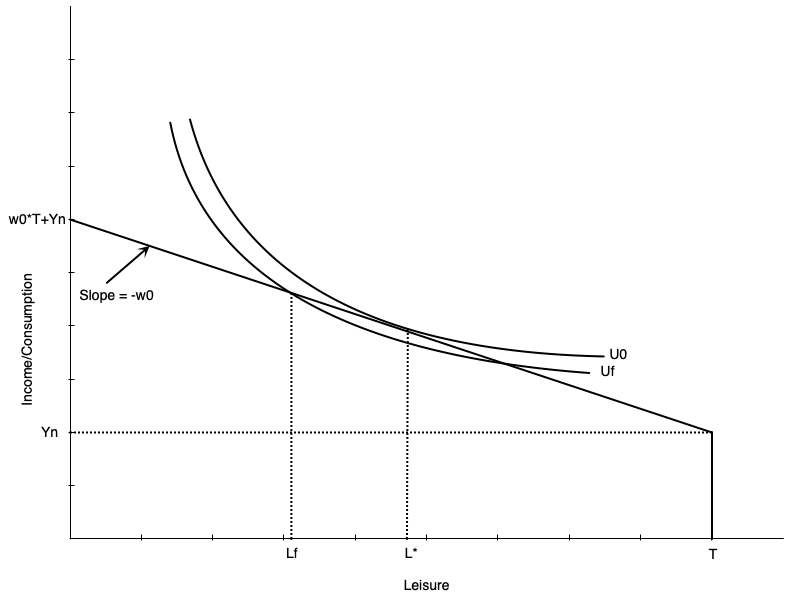
- In this graph, people would ideally work \(h^* = T-L^*\) hours
- Maximizes utility subject to budget constraint
- But employer requires them to work \(h_f = T- L_f\) hours
- Employer does not allow fewer hours
- Puts them on a lower indifference curve \(U_f\)
- They are overemployed — working more than they would choose at that wage
Overtime
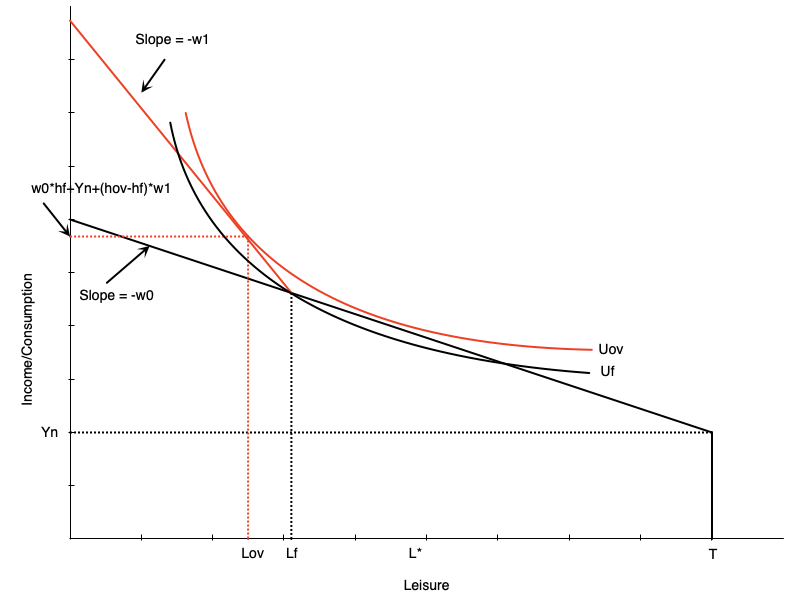
- If the employer offers overtime wages, the budget constraint pivots out from the fixed hours point
- Beyond those hours, the wage increases from \(w_{0}\) to \(w_{1}\)
- Allows worker to access higher utility curve
- Also increases hours worked even though they are initially overemployed
- The higher wage induces a substitution effect to work more
- There is a small income effect that only applies to the extra hours
- The alternative — paying more for all hours — is Review Questions 7 and 8